
Ocala Classic Car Guide
How to Safely Transport a Classic Car in Ocala (Without White-Knuckling the Whole Drive)
![[HERO] How to Safely Transport a Classic Car in Ocala (Without White-Knuckling the Whole Drive)](https://cdn.marblism.com/Nls_Xml6SGb.webp "[HERO] How to Safely Transport a Classic Car in Ocala (Without White-Knuckling the Whole Drive)")
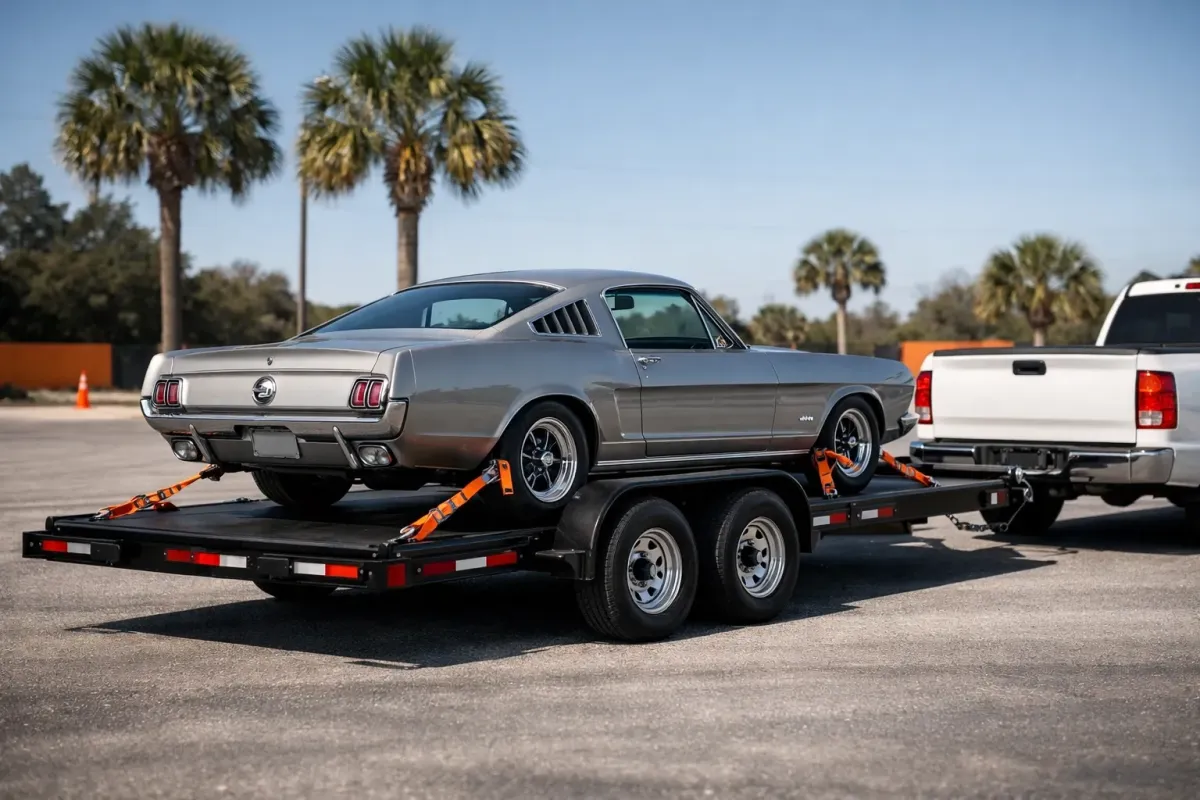
Your '67 Mustang doesn't belong on the back of just any trailer. Classic cars demand precision, planning, and the right equipment: especially when you're navigating Ocala's mix of highway speeds and downtown turns. Whether you're headed to a car show in Silver Springs or relocating your restoration project across Marion County, transporting vintage metal safely starts with knowing your gear and avoiding the rookie mistakes that turn a simple haul into an insurance claim.
Here's your complete guide to moving classic cars in Central Florida: covering everything from towing capacity to tie-down technique.
Start With Your Towing Capacity (Not Your Optimism)
Before you even look at a trailer, pull out your truck's manual and locate the towing capacity. This number tells you the maximum weight your vehicle can safely pull, including the trailer itself and everything on it.
Classic cars vary wildly in weight: a '72 Beetle tips the scales around 1,800 lbs, while a '69 Camaro SS can push 3,600 lbs. Add a 20' car hauler (roughly 2,300 lbs empty), and you're looking at a combined weight between 4,100–5,900 lbs minimum.
Quick math check:
Your truck's towing capacity: _____
Trailer weight: 2,300 lbs (empty)
Classic car weight: _____
Total towing weight: _____
If that total number exceeds your truck's rated capacity, you're risking transmission damage, brake failure, and a very expensive lesson in physics. Don't guess: verify your truck's specs and match them to the load before you commit.
Need help calculating your truck's limits? Check our towing capacity guide.

The Right Trailer Makes All the Difference
Our 20' Car Hauler is purpose-built for vehicles that deserve extra care:
14,000 lbs GVWR : room for heavy classics, muscle cars, and restoration projects without cutting it close
11,701 lbs load capacity : handles most classic vehicles with margin to spare
Slide-out ramps : low-angle approach that protects ground effects, exhaust systems, and front spoilers
Winch included : essential for non-running vehicles or cars with transmission issues
The slide-out ramps are the detail that matters most here. Fixed-angle ramps force you to approach steep, increasing scrape risk on low-clearance classics. Slide-out ramps extend the approach angle, giving you a gentler climb and protecting your undercarriage.
Perfect for vintage Corvettes, restored pickups, lowered hot rods, and any vehicle where the gap between bumper and pavement is measured in inches, not feet.
Hitch & Ball Setup: The Boring Stuff That Keeps You Legal
Your hitch and ball size need to match the trailer coupler exactly. Our 20' Car Hauler uses a 2-5/16" ball: the most common size for trailers in this weight class.
Before you hook up:
Inspect the ball for rust, cracks, or wear
Verify the weight rating stamped on the ball matches or exceeds your towing load
Check that the hitch receiver is securely bolted to your truck frame (not just sitting loose)
Attach safety chains in a crisscross pattern under the coupler
Plug in the electrical connector and test brake lights, turn signals, and running lights
Skipping this five-minute check is how people end up with a trailer bouncing down I-75 while their classic car rolls into a ditch.

Loading Your Classic: Balance Is Everything
How you position the car on the trailer determines whether you're driving straight or fighting the wheel the entire trip.
Proper weight distribution:
Position 60% of the vehicle's weight forward of the trailer axles
Too much weight in the rear causes trailer sway and reduces steering control
Too much weight up front overloads your hitch and lifts your truck's rear tires
Loading process:
Park the trailer on flat, level ground
Extend the slide-out ramps fully and secure them
Walk the ramps first: check for debris, loose bolts, or flexing
Drive slowly and straight up the center of the ramps
Stop when the vehicle is centered with proper weight distribution
Engage the parking brake and shift into park (or first gear for manuals)
Chock the rear wheels before unloading the winch
If the car isn't running, use the included winch to pull it onto the deck. Attach the winch hook to a factory tow point or frame-mounted anchor: never to the bumper, suspension components, or body panels. Winch slowly, keeping tension even to avoid rolling the vehicle off-center.
Tie-Down Technique: Four Corners, Zero Movement
Classic cars need to be secured at all four corners using axle straps or frame hooks: not by looping chains around suspension parts or fragile body panels.
The right way:
Use four ratchet straps rated for at least 3,333 lbs working load each
Attach straps to the vehicle's frame, axle, or designated tow points
Angle straps slightly downward and outward from the anchor point (creates downforce and prevents side-to-side movement)
Tighten straps until snug: firm pressure without compressing the suspension
Test each strap by attempting to rock the vehicle (it shouldn't budge)
What to avoid:
Straps attached to bumpers, body panels, or decorative trim
Over-tightening straps to the point where suspension compresses fully
Running straps over painted surfaces without protective padding
Check strap tension after the first 10 miles of driving and again at fuel stops. Straps settle and stretch during initial movement.
Route Planning for Ocala & Marion County
Florida roads present unique challenges: especially in Ocala, where you're mixing rural highways with downtown traffic and frequent construction zones.
Plan your route around:
Low-clearance obstacles : bridges, overpasses, and drive-thrus with height restrictions (your trailer + car height matters)
Sharp turns : downtown Ocala streets and parking lots require wide turning radius; avoid tight corners that force you to mount curbs
Construction detours : SR 200 and US 441 regularly close lanes; check FDOT traffic alerts before leaving
Fuel stops : plan stops at truck-friendly gas stations with pull-through lanes (backing up a 20' trailer in a crowded parking lot is a nightmare)
Stick to main highways when possible: I-75, US 27, and SR 40 offer smooth pavement and wide lanes designed for trailer traffic.
Florida Weather: Heat, Rain & Afternoon Storms
Central Florida weather changes fast, and both heat and rain create hazards for classic car transport.
Hot weather considerations:
Tire pressure increases as pavement temperature rises: check cold tire pressure before leaving and monitor throughout the drive
Asphalt softens in extreme heat, increasing stopping distance; leave extra space between vehicles
Brake components heat up faster when towing; use engine braking on long descents rather than riding the brake pedal
Rain and storm prep:
Secure loose items on the car (antennas, mirrors, trim pieces) that could catch wind or water
Reduce speed by 10–15 mph in wet conditions to account for reduced traction and longer stopping distance
Avoid standing water over 4 inches deep (can damage wheel bearings and trailer brakes)
Pull over and wait out severe storms rather than pushing through low visibility
Florida's afternoon thunderstorms roll in fast between May and September. Check radar before departure and build flexibility into your timeline.

Final Pre-Trip Checklist
Before you leave the driveway, walk the entire setup one last time:
Hitch and ball properly secured
Safety chains attached and crossed
Electrical connection tested (lights, brakes, signals)
Vehicle centered on trailer with proper weight distribution
All four tie-down straps tight and angled correctly
Tire pressure checked on truck and trailer
Emergency kit loaded (jack, lug wrench, spare tire, flashlight)
Route planned with fuel stops and rest breaks identified
Towing a classic car isn't complicated: it just requires attention to the details that prevent damage and keep you safe.
Rent the Right Trailer in Ocala
Our 20' Car Hauler is available for daily, weekly, and monthly rentals: designed for classic car enthusiasts, restoration shops, and collectors who need reliable equipment without the commitment of ownership.
Included with every rental:
Slide-out ramps for low-clearance vehicles
Winch for non-running cars
Pre-trip safety inspection
Delivery available within 35 miles (fee applies)
Flexible rental periods let you book for a single weekend car show or a month-long restoration transport project.
Reserve your car hauler rental today.
Questions about towing capacity, loading technique, or route planning? Reach out: we're here to help you move your classic safely, whether it's across town or across the state.